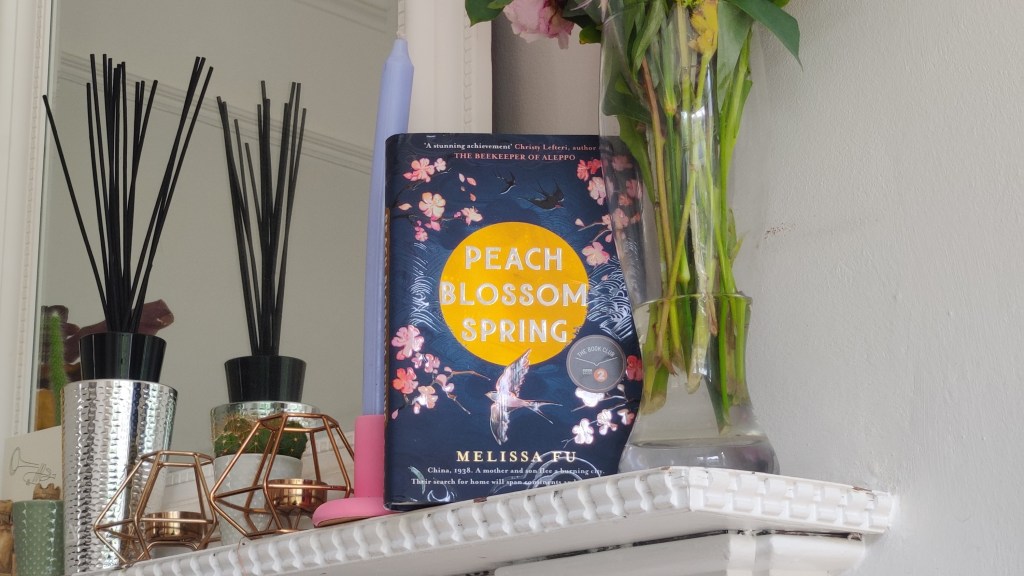

THE PLOT: ‘Peach Blossom Spring’ by Melissa Fu is a historical novel that spans generations and continents. Starting in China, 1938, a young mother and her son flee the Japanese invasion. Their epic journey twists and turns throughout World War II but when the communist revolution comes, the family ends up rebuilding their lives in Taiwan. Yet the fear of Chiang Kai-Shek’s government and longing for their homeland never ceases. Years later, in America, a man refuses to talk about his traumatic childhood, thereby denying his westernised daughter her heritage. Ending in 2005, this novel is the history of modern China told through one family.
RATING: I love multi-generational, multi-POV stories so I had such high hopes for this novel. Luckily it didn’t disappoint as the writing was atmospheric, the characters were endearing and the plot was exciting (initially). Reading this book, I vaguely recalled my GCSE history lessons about Chiang Kai-Shek but I’m ashamed to realise that I never truly thought about those who were living in Taiwan (too focussed on Mao Zedong and mainland China). Therefore, this book broadened my perspective on this period of Chinese history. Unfortunately, I do think the final third of the book dragged and Henry’s decisions felt a little illogical (even though I understand that he was having a trauma response), so it’s not quite one of my favourites. However, it’s a solid four and a half stars and I’d be excited to read what the author publishes next.
GOOD BITS: Ignoring the sneaky prologue, I think this novel has one of the best openings I’ve read in a long time. I was immediately sucked into the story and loved our main character, Meilin. She feels like such a good mother and her survival instinct and the relationship between her and the other female characters kept me invested. On a technique level, the author does a very good job of subtly alternating the narration between Meilin and her son Renshu. These changes of POV aren’t announced but they are each new scenes and Renshu’s perspective is signalled by calling his mother ‘Ma’ instead of her name. This allows the author to move into Renshu’s perspective more and more as the novel progresses and is something I’ll definitely take into my own writing.
“Dao Hongste had three wives. Their names are not important.”
– Melissa Fu, Chapter 1
NOT SO GOOD BITS: The back third of the novel dragged. I felt like I was done with the story and could not fathom why it was 150-pages too long. By the end, I did come to like Henry and Lily’s story but it felt like a somewhat average tale of growing up mixed-race and not understanding your identity, which I’ve read a million times. It helped that Lily is a very likeable character and reading it with the scope of the whole family history in mind shows trauma is never many generations away. But the end felt lacklustre compared to the beginning of the novel, which was much more exciting and dramatic.
OVERALL: I’d recommend this book to lovers of ‘Pachinko’ by Min Jin Lee, ‘Black Cake’ by Charmaine Wilkerson, ‘How We Disappeared’ by Jing-Jing Lee and ‘Homegoing’ by Yaa Gyasi. If you like multiple POVs, family sagas and sprawling epics, this is a book for you.
Thank you to @ReadWithSabs who gave me this book for my birthday, knowing I’d love it like she did. This book is available to order on my bookshop.org profile.

 Amina's Bookshelf