
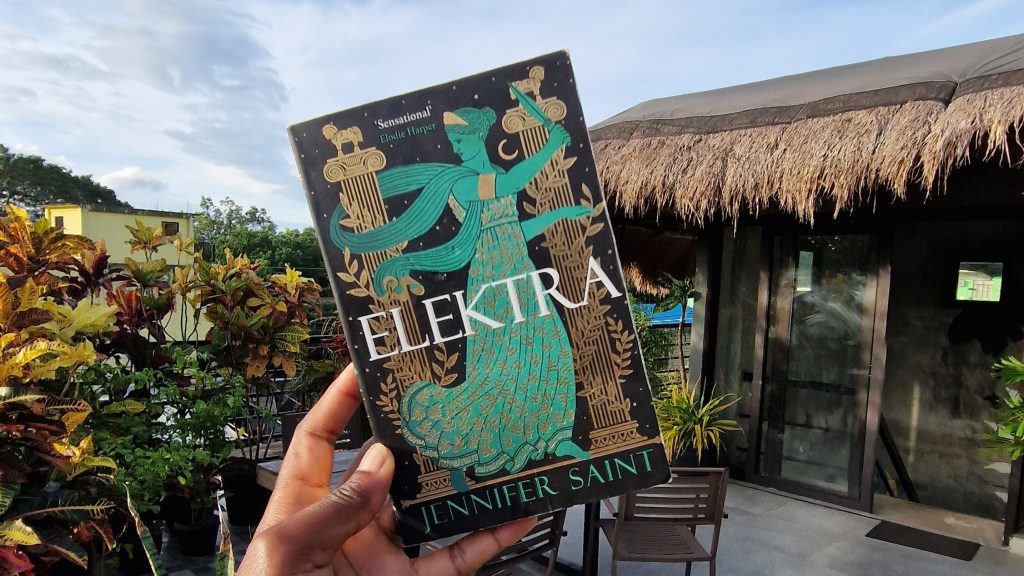

THE PLOT: ‘Elektra’ by Jennifer Saint is a Greek mythology retelling of the Trojan War. Told through three women, it focuses on the House of Atreus, which is cursed throughout the generations. Clytemnestra’s hopes of averting the curse are dashed when her sister, Helen, goes to Troy and her husband, Agamemnon, is determined to start a war to get her back – whatever the cost. Cassandra’s cursed by Apollo to see the future destruction of her city, but to never be believed. Elektra, the youngest daughter of Clytemnestra and Agamemnon, seeks to escape the curse but her destiny is also bound by violence. When all three women come together in Mycenae after the war, the Furies must intervene.
SUMMARY: When I studied classics at university Aeschylus’ Agamemnon was one of my favourite plays, so I was really looking forward to this novel. The psychology of Clytemnestra (“a woman who manoeuvres likes a man”) has always fascinated me and I can recite Cassandra’s dying speech from memory. Luckily, this book didn’t disappoint and the characterisation of both women is relatable and compelling. I love how Clytemnestra’s relationship with Helen is at the forefront and I kept rushing back to Cassandra’s chapters because I loved seeing the fall of Troy through her eyes. However, the ending felt a bit rushed and Elektra was very annoying (though I also find her a whiny lil bitch in Sophocles, so maybe it’s a me-thing). Overall, an enjoyable read for mythology lovers and the plotting felt tighter than Saint’s earlier work.
GOOD BITS: Despite the title of this novel, my favourite point of views were Clytemnestra and Cassandra. I felt Clytemnestra’s characterisation was very well done through depictions of her betrayal and depression. Focussing on her being Helen’s sister was clever and her relationship with Aegisthus had a great balance. She was able to be the badass ruler yet still vulnerable, which is testament to Saint’s writing. Also, I was most excited for Cassandra’s chapters because I loved seeing the Trojan War through her perspective. No spoilers but there were little tweaks to Cassandra and Elektra’s traditional storylines to give them more agency, which was a brilliant addition to the plot.
NOT SO GOOD BITS: The ending felt rushed and there was no resolution of the Furies’ intervention. Maybe it’s because I studied Sophocles’ Eumenides, but I do think it’s necessary to give more time to the judgement of the gods. There was so much focus on the curse that the novel failing to give it’s breaking enough airtime made the ending feel abrupt. There was also ongoing commentary on the role of the gods throughout the novel so it would’ve felt more complete if it ended with the establishment of law, like the original myth.
OVERALL: I’d recommend this book to fans of ‘Ariadne’ by Jennifer Saint, ‘A Thousand Ships’ by Natalie Haynes, and ‘The Women of Troy’ by Pat Barker. Thank you so much to Claire (@bookishreadsandme) who sent me this book for secret santa.
If you’d like to buy this book, you can support aminasbookshelf and get a discount by using my bookshop.org affiliate link.

 Amina's Bookshelf