
THE PLOT: ‘Dust Child’ by Nguyẽn Phan Quẽ Mai is a dual-timeline historical novel focussed on the American-Vietnam War. In 1969, two sisters leave their rural village to work as bar girls in Saigon, where they are paid to flirt with G.I.’s. In 2016, Dan, a former American helicopter pilot, returns to Ho Chi Minh city in an attempt to soothe his regrets about his actions in the war, and to find his ex-girlfriend Kim. Meanwhile, Phong is one of thousands of mixed-race children abandoned by their Vietnamese mothers and American fathers. Despite a tough upbringing of poverty and shame, he is determined to find his parents and get a visa to the U.S. When their lives intertwine, family secrets are revealed.
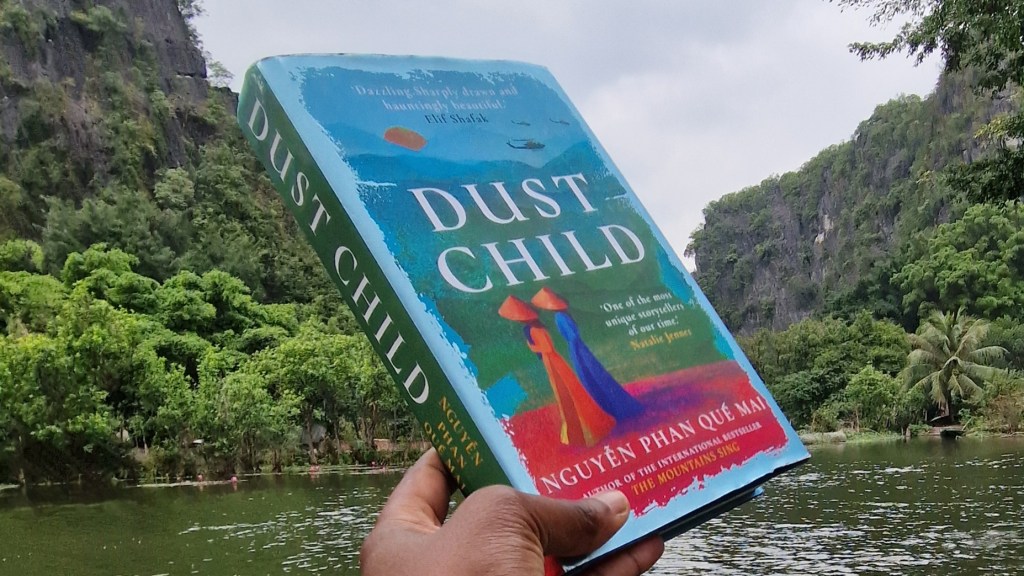
SUMMARY: Reading this novel in the author’s childhood town of Ninh Bình felt like a huge privilege and I loved being able to connect with this novel in its country of origin. This book sheds light on the plight of Amerasians and the traumatic legacy of the American-Vietnam War, skilfully using four protagonists to showcase the war’s varying impact. I was particularly moved by the depiction of racism in the novel, both towards the Vietnamese, Black soldiers and their mixed-race Black-Vietnamese children. If I’m completely honest, I struggled slightly with this author’s writing style because it’s a bit too explanatory and moralistic for my tastes. However, I truly admire this author as she works so hard to educate the world about Vietnam, fight discrimination faced by Amerasians and has done copious amount of research for this novel, including real-life searches to reunite family members. The author is also a great champion of book bloggers and booksellers, and I love to promote her work because she seems like a kind, caring and generous individual. Therefore, I’m giving this book four stars and, if you’re interested in the blurb/themes, I urge you to buy a copy.
GOOD BITS: I love a multi-POV, multi-timeline novel and I enjoyed the way these perspectives weaved together. The fact they intersected early, rather than waiting for the end of the novel, was very satisfying, and it was interesting to see each character develop alongside each other, rather than having each of their stories in isolation. My favourite characters were Trang and Quýnh, and I kept wanting to get back to their chapters during the war because they were so exciting and emotional. I also didn’t see the twist at the end of the book coming!
NOT SO GOOD BITS: I know many people loved the writing style of this novel and it reminded me (stylistically) of other historical novels that were adored by bookstagrammers but didn’t quite hit the spot for me. However, I just didn’t connect with the characters enough because the writing style felt too distant. Perhaps it’s too much ‘telling’ instead of ‘showing’, or perhaps it’s feeling like the author is giving me a moral rather than presenting the themes through the emotionality and actions of the characters. I can’t put my finger on it, but I prefer to dive into the complex psychology of a character, so this type of writing just feels a bit laboured and over-explanatory for me.
OVERALL: I’d recommend this book to fans of ‘Rose and the Burma Sky’ by Rosanna Amaka, ‘73 Dove Street’ by Julie Moylan, and ‘How We Disappeared’ by Jing-Jing Lee. Nguyẽn, Amaka and Moylan have a similar style of writing historical fiction which I know many bookstagrammers love, even though it doesn’t 100% suit my storytelling tastes. These books also deal with similar themes regarding war, feminism and colonialism.
If you’d like to buy this book, you can support aminasbookshelf and get a discount by using my bookshop.org affiliate link.

 Amina's Bookshelf