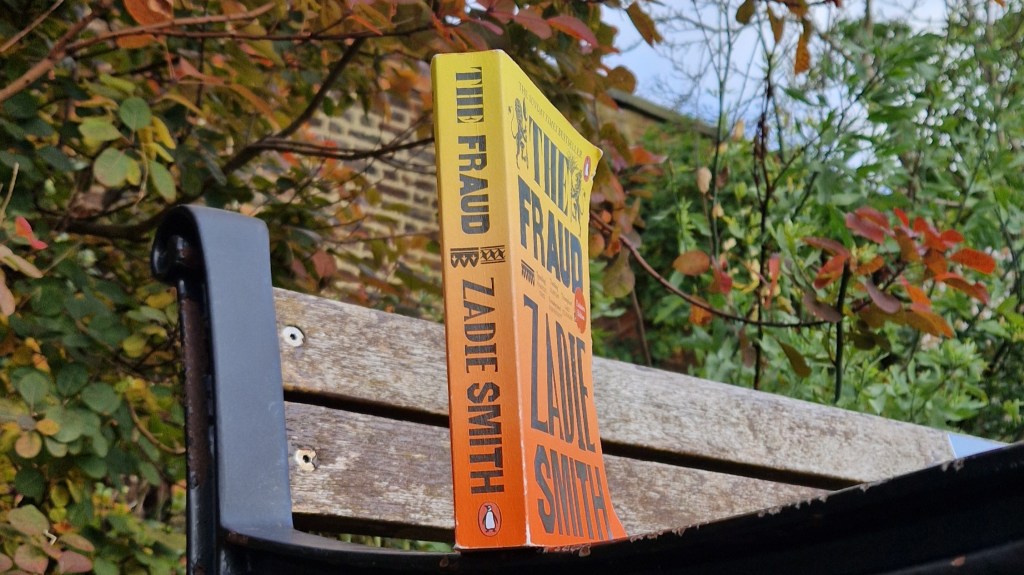

THE PLOT: ‘The Fraud’ by Zadie Smith is a historical novel set in Victorian England. Eliza Touchet is cousin-by-marriage and housekeeper to failing novelist William Ainsworth. A firm believer in women’s rights and abolition, Eliza is a progressive sceptic who disparages William’s marriage to a low-class maid (Sarah). But when Sarah becomes obsessed with the famous ‘Tichborne Trial’, Eliza finds herself transfixed too. The real-life trial of the Tichborne Claimant saw a cockney butcher who had recently returned from Australia lay claim to the Tichborne Baronetcy. But what Eliza finds most fascinating is Tichborne’s star-witness, Mr Bogle – a former slave from Jamaica. In a world of self-deception, Eliza is determined to find out whether Mr Bogle is telling the truth.
SUMMARY: Oh Zadie, why? I loved Smith’s other novels so I hate to say this but… this book is not good. Yes, art is subjective but I’d argue that the structure of this novel simply does not work. Each short (c.3-page) chapter jumps back and forth in time in a way that often feels illogical. You never know quite whether you’re in the past or present, and what the significance of that is. The main character, Eliza, is extremely passive to the point where she is simply a witness to a trial in the ‘present-day’ action. Similarly, in the ‘past’ she is a bystander to her cousin’s meteoric rise and then floundering career. Her lack of agency makes the novel feel extremely flat. To be fair, the writing is good and the Victorian style shows immense talent in world-building. But this imitation of a Dickensian serial didn’t seem to have any significance. Almost like a tracing paper copy of a novel written two-hundred years ago, I was left wondering if the format of the book was a reference to ‘the fraud’ in the title.
GOOD BITS: I enjoyed aspects of Eliza’s story, particularly her relationships with her cousin and his wife (no spoilers but IFYKYK). Her reaction to the slave-trade was poignant and is a great commentary on arm-chair activism. The character of Sarah grew on me, though she was a bit of a stereotype. But the most engaging section is the 100-page interlude of Mr Bogle’s story in Jamaica. I deeply questioned whether it was right for me to only engage with the slavery story. Slavery is not the only Black narrative and does not need to be at the centre of every Black writer’s story. Ultimately, I think this was the best part of the book because it was the only section with real stakes. The high’s and low’s of a Black character in Victorian England going from a slave to venerated figure in society is inherently more interesting than a middle-aged woman who is bored of her life in England.
NOT SO GOOD BITS: I think Zadie Smith lost the plot. Literally. She was trying to do something experimental, but lost sight of the core of any novel; a character with a want/need who takes action. Nothing really happens in this book yet there are tons of characters. Most of them are there for no reason. Even the vaguely interesting ones, like Charles Dickens featuring as a scoundrel, feel like name-drops rather than real people in a real story. I kept waiting for some kind of reveal or twist to tie it all together – something to show that Eliza was actually a fraud and somehow linked to Mr Bogle and the Tichborne’s. I’ll save you all time by stating this never happens. There is no link, no reason for the story.
OVERALL: I’d recommend this book to fans of ‘Bleak House’ by Charles Dickens, ‘Middlemarch’ by George Elliot, and ‘Of Human Bondage’ by W.Somerset Maugham. But, honestly, I can’t recommend this book. It’s trying too many things and fails to be any of them.
If you want to decide for yourself, you can purchase this book and support @aminasbookshelf on my bookshop.org page

 Amina's Bookshelf