
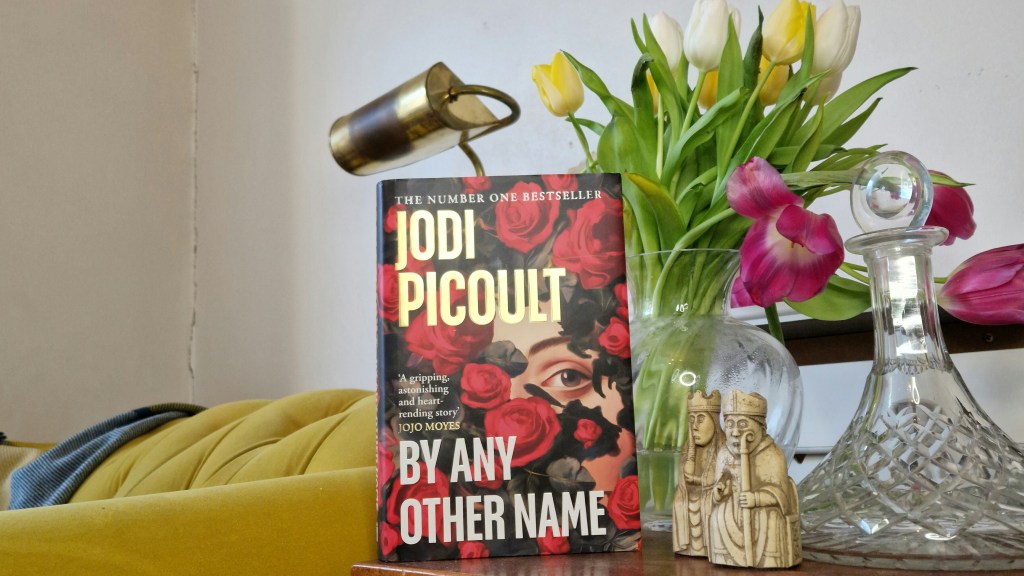

THE PLOT: ‘By Any Other Name’ by Jodi Picoult is a dual-timeline historical novel which posits Emilia Bassano – a Jewish woman – wrote Shakespeare’s plays. In Elizabethan London, Emilia Bassano gets an exemplary education as a ward of English aristocrats. But when her patron marries, Emilia is forced to become a mistress to wealthy Lord Chamberlain, who oversees all theatrical productions in London. Emilia discovers a love of stories and secretly plans to stage a play of her own. But women aren’t allowed in theatre so she must use an alias, paying an actor named William Shakespeare to front her work. In modern-day Manhattan, Emilia’s ancestor is a young woman trying to make it as a playwright. Struggling to survive, she takes a lesson from history and submits a play under a male pseudonym.
SUMMARY: I adored Jodi Picoult’s books as a teenager and I’m a huge fan of historical fiction so I really expected to love this novel. However, there are just too many faults for me to ignore. Firstly, I want to clarify that this book is well-written. Jodi Picoult is an accomplished author who knows how to put a sentence together. Alas, it was the characters, plot structure and didactic themes that made this fall apart. The timeline of the historical narrative was way too long and ended up meandering through the character’s lifetime, rather than being a tight, cohesive plot with a clear story arc. And, while I do appreciate and align with the themes about feminism, racism and gender, they were so heavy-handed. It felt like this novel was just an excuse for the author to set out her views. The heart of this novel is interesting and I’ve been convinced by Picoult’s argument that Shakespeare did not write his own plays and enjoyed learning about the real-life figure of Emilia Bassano. However, this central thesis, along with the over-blown theme of women’s voices in theatre, overshadowed the story.
GOOD BITS: Writing this review is difficult because I enjoyed the Elizabethan timeline and the main character, Emilia Bassano. As an intelligent woman forced into prostitution and marriage, she had a strong personality and there were very compelling plot elements. However, the historical timeline fell off a cliff in the last 150 pages. You can tell Picoult doesn’t generally write historical fiction because she tried to stick to the real historical figure’s lifetime too rigidly. We end up following the character into old age, where events are crammed in and don’t feel satisfying for the plot. We’re even introduced to her grandchildren very late in the novel and follow their lives, although they don’t contribute to the story as a whole.
NOT SO GOOD BITS: The modern-day timeline simply didn’t work. The main character is supposed to be a 30-something aspiring playwright living in New York but it’s just not believable. From small things, like reading newspapers instead of utilising social media, to bigger things, such as living in an apartment without a stable job, it got more and more frustrating as I kept reading. I just couldn’t understand why she didn’t take more initiative in her career and it felt like reading about 2003 instead of 2023. There were some interesting elements regarding feminism and racism, but the treatment of these was also stuck in the past. I just don’t believe these characters would have such a basic understanding of intersectionality. Ultimately, the ending is where I really gave up with this novel. There’s a strange meta-theatrical ghost story where the timelines converge in a way that feels farcical.
OVERALL: I’d recommend this book to fans of ‘Hamnet’ by Maggie O’Farrell, ‘The Seven Sisters’ series by Lucinda Riley and ‘Tom Lake’ by Ann Patchett. However, this novel is probably a mis-mash of those books and fails to be as good as any of them. Thank you to Penguin Michael Joseph for my #gifted copy in exchange for an honest review.
You can purchase this book and support @aminasbookshelf on my bookshop.org page

 Amina's Bookshelf