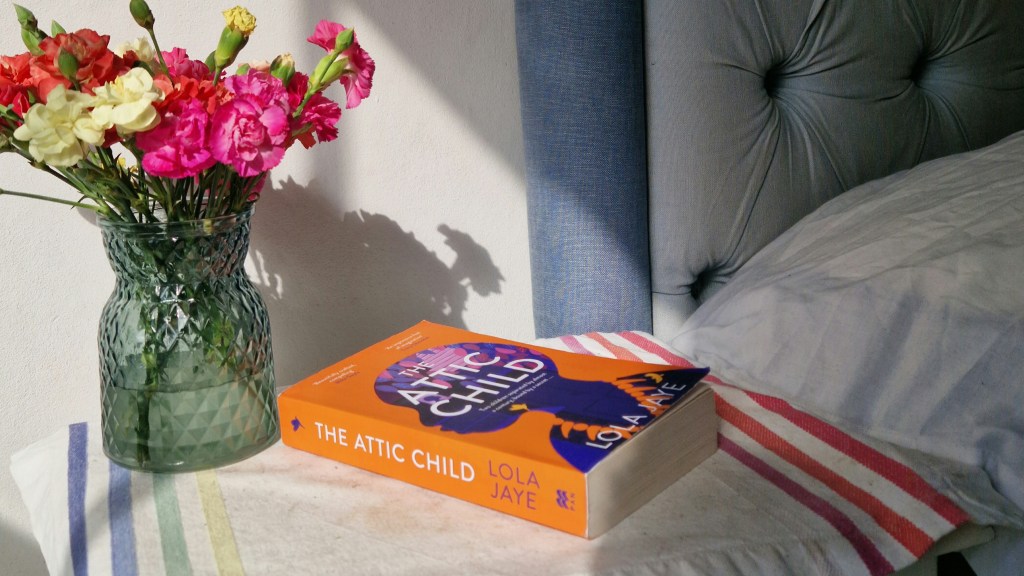

THE PLOT: ‘The Attic Child’ by Lola Jaye is a dual-timeline historical novel about two children banished to the same attic almost 100 years apart. In 1907, twelve-year-old Celestine is taken from the Congo to England to be a companion to a wealthy explorer. But, once his patron dies, he is locked in the attic and forced to be an unpaid servant. In 1993, Lowra is a traumatised young woman who clings onto a necklace she found in the attic of her childhood home. Still disturbed by the neglect and abuse she experienced at the hands of her step-mother, Lowra embarks on a journey to find the necklace’s owner.
SUMMARY: Everyone lied about this book. I saw so many great reviews of this novel. It was on the top of my wishlist for ages and I rushed to get it in paperback. But, now I’ve read it, I’m never trusting #bookstagram recommendations again. Now, I know reading is subjective but this is an objectively bad book. The writing style lacks depth, the structure leaks tension, the plot hinges on coincidence, the characters have no motivation for their actions, and there is absolutely no narrative momentum in the ‘present-day’ storyline. I absolutely love historical fiction written by Black women so it pains me to write this. But the only reason I’m even giving this book two stars is because of the interesting premise, themes of racism, colonialism and child abuse, and the core story in Celestine’s POV.
GOOD BITS: Celestine’s storyline as a child was interesting, and his journey from his native land to England to be used as a prop was compelling. Showing this character in a position of relative power in society and how he had to confront his own biases after his patron’s death made for a complex exploration of the themes of racism and colonialism. I also enjoyed the interlude while Celestine was at school, although it didn’t seem to go anywhere. I do wish we’d got a deeper reason for Sir Robert bringing him to England in the first place. If this had been tied to the sexual abuse, it would’ve felt more realistic and integrated into the overall narrative.
NOT SO GOOD BITS: I usually love a dual-timeline / dual-POV novel, but I truly despised Lowra’s storyline. I couldn’t connect to the character at all. The author relies on backstory to give Lowra any personality, but the present-day character is far too aloof and numb to make a compelling protagonist. In an attempt to withhold information from the reader, the author fails to show any interiority or spectrum of emotion. I could’ve forgiven this, but there isn’t really a strong plot in her timeline either. There is no motivation or external pressure for Lowra to embark on the quest of tracking down Celestine and no stakes if she fails. It’s just pointless.
I feel the need to justify why I hated this book so much, so here’s a breakdown of the key elements.
- Writing style: On a sentence-level, the writing in this novel is very basic. Personally, I’m not a huge fan of novels written in first-person, past-tense. I think it works with unreliable, complex narrators because they are editing their own story with the benefit of hindsight. However, in this instance it made the storytelling extremely flat. There was no subtext and the emotional calibration was all ‘telling’ rather than ‘showing’. The author often relied on sentences like ‘I felt sad’ or ‘I felt confused’ rather than rooting the reader in that emotion.
- Plot: The most interesting bit of the novel is the core of Celestine’s story and I think this is because there’s an antagonist. Whether it’s Sir Robert or Agatha Mayhew, we have secondary characters who prevent Celestine from achieving his goals. In Lowra’s storyline and the latter half of the novel, all of the antagonistic forces are in the past. Therefore, there’s no momentum to keep the plot going. It just becomes a series of events which happen to both Celestine and Lowra. This means it feels like the novel is wrapping up for ages and there’s no reason for me to care about what happens to the characters.
OVERALL: I’d recommend this book to fans of ‘Rose and the Burma Sky’ by Rosanna Amaka and ‘The Mountains Sing’ by Nguyễn Phan Quế Mai. These are other popular books where I really admired the premise and authorial intention, but struggled with the writing style and lack of active scenes/escalating plot. But, honestly, I think this is the worst of the bunch and I really wouldn’t recommend it to anyone. I chose this book for the No Shelf Control bookclub run by @mytreasureinbooks and @letsgetreadical and I’m sorry to everyone who had to read it.
You can purchase this book and support @aminasbookshelf on my bookshop.org page

 Amina's Bookshelf