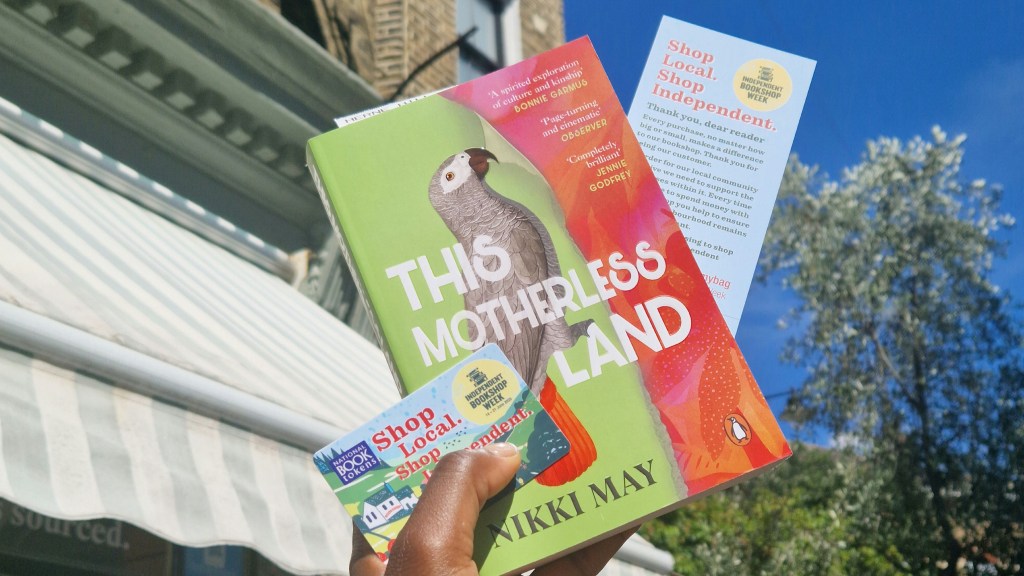

THE PLOT: ‘This Motherless Land’ by Nikki May is a retelling of Mansfield Park set in Lagos and Somerset. In 1978, after a tragic accident, mixed-race Funke is sent to live with her posh maternal family in England. Faced with racism and neglect, Funke attempts to assimilate to survive. Meanwhile her cousin, Liv, is delighted at having another young girl in the sprawling country house. Desperate to break free of her joyless upper-class family, Liv becomes Funke’s best friend and protector. But, as they get older, the divisions of class, race and wealth form a chasm between Funke and Liv, and they both make choices that could end their friendship forever.
SUMMARY: This novel has a very rare strength – it has a hell of a lot of plot. I could write a treatise on editing in modern publishing but, the crux of the matter is, a lot happens in this book and it is, fundamentally, very entertaining. In fact, it is very rare for me to write this in a book review but I actually think this book could’ve slowed down and taken its time to let the characters unfurl. The core of this novel is about the relationship between two cousins: one Black and one white. Despite their love for one another, they both struggle to fit into each other’s worlds. There are a lot of problematic themes and views expressed in this novel, either by explicitly racist characters or the value-system baked into it. But what makes me give this novel a high star rating is its honesty. Although it’s difficult, the author doesn’t shy away from a realistic portrayal of what it means to be mixed-race in rural Somerset in the 1980s. And, although some scenes veer into soap-opera, I’ll always back an entertaining book with emotional truth at its heart.
GOOD BITS: This book feels like reading Enid Blyton with Black characters. The vibe and world-building is spot on. It transported me to shivering awkwardly in friends’ grandparents’ country houses and then shunted me to memories of bucket baths in Lagos. The Jane Austen inspiration feels present in the old, creaky mansions and stiff upper lips, but it’s not overbearing so this story is allowed enough breathing space to tap its own roots. Funke is a great character and, though exaggerated for entertainment, many will relate to the Black-British and mixed-race experience through her eyes.
NOT SO GOOD BITS: I have no idea why the blurb says this book is set in modern-day Lagos. It is primarily set in the 1970s to 1990s, making it historical fiction (as much as it pains me). I think this context is so important because it frames how we assess the themes of race and class. Honestly, this book feels slightly problematic. It’s not the explicitly racist and prejudiced characters, but more in the value-system at its core. Perhaps it’s the subtle yet constant criticism of Nigeria’s infrastructure or the feeling that England (and the White-British characters) inherently represent the “proper” way to do things. My truth is that some of the stereotypes feel a bit off and I don’t know how to express it. But on the other hand, I think there’s an honesty to the stereotyping of some of the characters (both English and Nigerian). There’s a true depth and complexity to the portrayal of race is this book, perhaps even beyond the author’s intention. I like how it’s challenging my mindset and perspective. This would make a great novel for a book club.
P.S., Liv annoyed the hell out of me in the later chapters. She lost the spark of her childhood and became such a whiny, over-privileged character. Even though this was deliberate, I started to get annoyed that we spent so much time in her POV instead of Funke’s. Also, it felt like I was racing through events at times. It’s strange because there was excellent causality, but it felt a bit like; ‘and then that thing happened, and also this, and another thing,’ as the story hurtled towards the climax.
OVERALL: I’d recommend this book to fans of ‘Black Cake’ by Charmaine Wilkerson, ‘My Life as a Chameleon’ by Diana Anyakwo, ‘Fruit of the Lemon’ by Andrea Levy, and ‘The Misinterpretation of Tara Jupp’ by Evie Rice. If you love period dramas, dual POVs and big timelines this is a book for you.
You can purchase this book (with a discount) on my bookshop.org page!

 Amina's Bookshelf