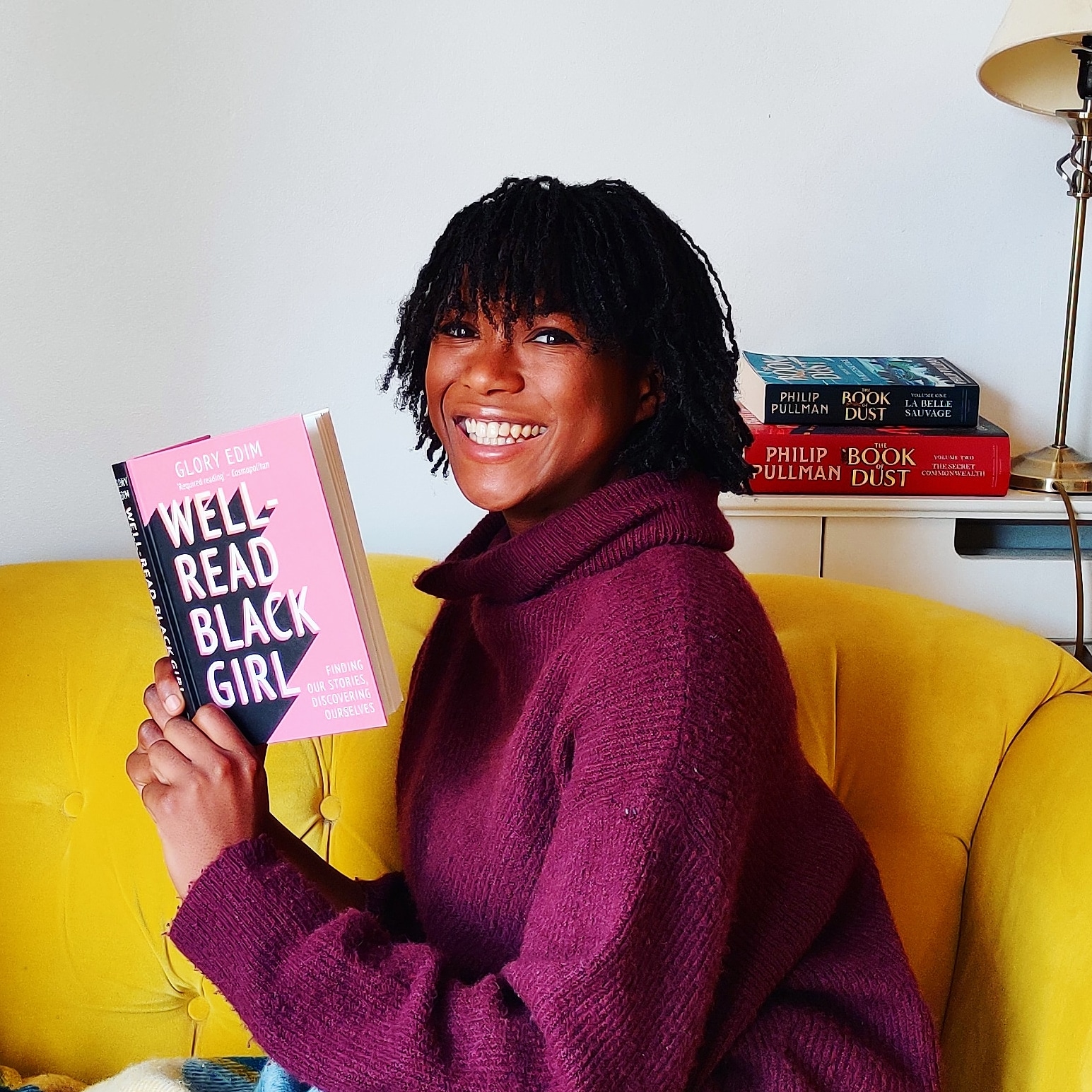

Autumn is here! I’m usually a summer girl and live for long days reading outside. But, for once, I’m excited for cosy season. I’ve recently moved to the Somerset countryside and watching the leaves change colour and colder days set in has me anticipating evenings reading by the log burner. We’ve got a lot of work to do on the new house, so for the next few months you’ll also catch me listening to an audiobook while cleaning and painting and fixing the myriad broken items. Luckily, I’ve got a bumper list of wonderful audiobook recs for you all. Reach out on IG and TikTok (@aminasbookshelf) to let me know if you’ve read any of these and if you enjoyed them too.
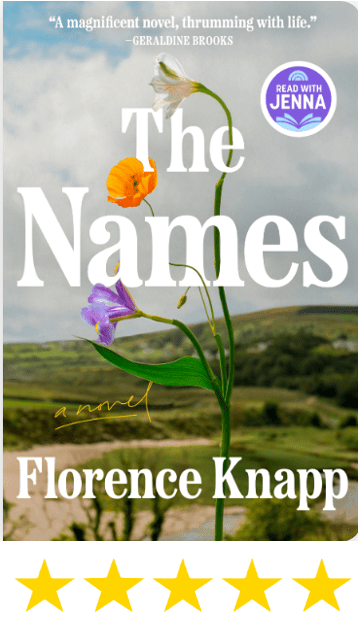
The Plot: ‘The Names’ is a contemporary upmarket novel about three alternate versions of a family’s life, shaped by the mother’s choice of name for her son. In the wake of a catastrophic storm, Cora sets off with her nine-year-old daughter to register her son’s birth. Her husband, a respected local doctor but a terrifying presence at home, intends to name the infant after himself. But when the registrar asks what she’d like to call the child, Cora deliberates over three choices. In alternating timelines, the novel explores what life would have been like if she’d chosen each different name.
Rating: This is a beautiful book. The central theme is domestic abuse and coercive control, but this novel offers a new perspective, allowing the reader to understand the impact of abuse from multiple different angles. It’s extremely emotional and, at times, distressing but this speaks to the author’s ability to bring characters to life and immerse you in a story. This novel shows how domestic abuse can become a family cycle that’s hard to break out from and the resilience needed to overcome that trauma. This “Sliding Doors” style narrative feels unique and intriguing, keeping the reader invested in all three alternating timelines. Part of me wishes I’d read the physical book to really enjoy the use of language in this novel, but the audiobook is wonderfully read and was the perfect accompaniment to long, country walks.

The Plot: ‘Don’t Let Him In’ is a thriller about several women connected by a deceptive, cruel man. Recent widow Nina Swann is intrigued when she receives a condolence card from Nick Radcliffe, an old friend of her late husband. Nick is an attractive older man of substance and good taste. But to Nina’s adult daughter, Ash, Nick seems too slick, too polished, too good to be true. Without telling her mother, Ash begins digging into Nick’s past. What she finds is more than unsettling…
Rating: Lisa Jewell knows how to write a high-concept thriller. She hooks you, keeps you guessing and delivers a sucker-punch revelation at the end. Perfect for long drives, this novel is entertaining yet delivers the psychological elements I need in a thriller. I love piecing together the elements of a book and I enjoyed trying to work out what Nick was up to. Although I was able to guess many of the twists, there were so many developments that I didn’t feel bored. That being said, I got confused several times in this novel because there are so many different women and aliases and timelines. Even when I was halfway through, I didn’t know many of the main characters’ names. This sounds so basic, but I think the names were just too similar. I kept mixing up Martha, Tara, Nina and Amanda. It might be deliberate to show how the women are experiencing the same issues, but I think this could have been easily fixed if some of the names were more original (or just didn’t end in ‘a’).
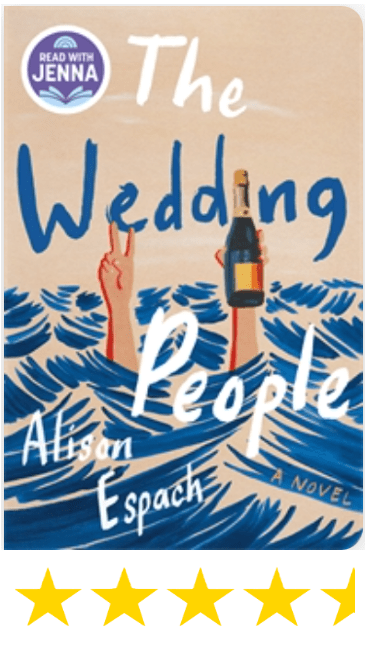
The Plot: ‘The Wedding People’ is a contemporary novel about a woman who goes to a hotel to take her own life but ends up being involved in a wedding. When Phoebe Stone arrives at a fancy hotel, she’s immediately mistaken for a wedding guest. After all, the whole venue is booked out for a very expensive celebration. But due to an administrative error, Phoebe is the only person who isn’t there for the big event. Phoebe is there because her husband had an affair and she is determined to have one last decadent splurge before taking her own life. Meanwhile, the bride has accounted for every detail and every possible disaster the weekend might yield except for, well, Phoebe.
Rating: This book has been criticised for its light-hearted approach to suicide and lack of trigger warnings. While I do agree that trigger warnings for suicide, infertility and baby loss should be included, I’m not mad at this novel. In fact, I really enjoyed it. The absurd premise and edgy, sarcastic tone allow for a surprisingly funny and tender novel about the meaning of love, loss and friendship. Although Phoebe was a bit too ‘woe is me’ and Lila, the bride, is annoying and self-centred, I kind of loved them and their dynamic. It felt like a portrayal of an honest friendship, particularly when the other relationships in the book were well-observed depictions of stilted or frustrated dynamics. The second half of the book lagged for me as it became much more of a budding romance than a friendship novel. Yet I really liked this book overall and would be keen to read more of the author’s work.

The Plot: ‘Atmosphere’ is women’s fiction about female astronauts in the 1980’s. Joan Goodwin has been obsessed with the stars for as long as she can remember. A professor of physics and astronomy, she sees an advertisement seeking the first women scientists to join NASA’s space shuttle program. Selected from a pool of thousands of applicants in the summer of 1980, Joan begins training alongside an exceptional group of fellow candidates. As the new astronauts become unlikely friends and prepare for their first flights, Joan finds a passion and a love she never imagined.
Rating: I don’t like reading romance. “Will they? Won’t they?” just isn’t my cup of tea. But, if you combine romance with a period drama, or make it sapphic, or if it’s a subplot in a wider story, then I’m in. So, you’ll be mildly surprised to hear that I really enjoyed listening to this novel. Although I loathe to say 1980s is historical fiction, what drew me in was the feminist angle and understanding of the difficulties faced by women in STEM and space exploration. The friendships and rivalries between the different astronauts interested me, and I liked the additional dimension of Joan’s complex relationship with her sister and love for her niece. This book was great for housework – entertaining, easy to digest and not too complex. I don’t think it’ll be winning the Booker Prize anytime soon, but I learned something about space, rooted for the triumph of gender equality, and enjoyed the sapphic romance / general themes of queerness and queer characters, and that’s good enough for me.
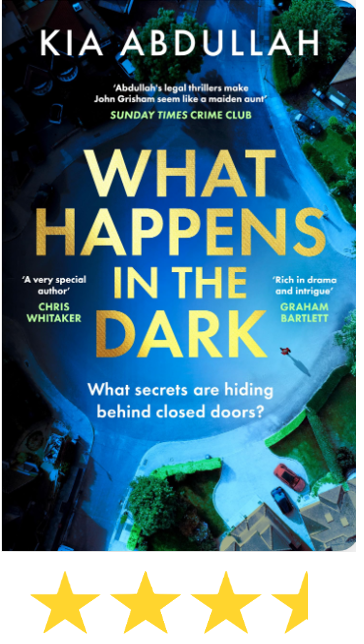
The Plot: ‘What Happens in the Dark’ is a thriller about two friends at the centre of a court case for murder. Lily and Safa were best friends growing up. Now, Lily is the nation’s favourite breakfast TV presenter and Safa, once a renowned journalist, is reeling from a recent fall from grace. When news breaks about suspicious bruises on Lily’s body, Safa attempts to rekindle their old friendship for an article. Lily claims the bruises are nothing to worry about but then the police are called to Lily’s home – where a body lies dead. Drawn by their connection, Safa begins her own investigation into what happened that night. But Safa is not prepared for what her quest for justice will uncover.
Rating: Kia Abdullah’s novels mix psychological thrillers with court room dramas and women’s issues in an explosive, propulsive way. Although I liked this novel, it just wasn’t my favourite of hers. The dynamic between Lily and Safa was interesting, particularly their reversals of status and Lily being in the public eye. But the reveal felt like a let-down, and I don’t think they explored the characters to their full potential. I guessed the twist very early on yet still hoped for a stronger motivation for the murder (which never came). Lily was a complex character and her history was so interesting, but her psychology didn’t have much impact on the resolution and all that build up didn’t go anywhere. I wish the social media aspect was baked into the subplot from the start because it felt a bit random. As Lily was a celebrity, the role of social media could’ve played into the trial and linked the elements together a bit more. Safa’s subplot investigating the assault of Muslim aunties was very interesting but it felt like a set-up for another book, rather than being resolved in this novel and linked to the main story.

The Plot: ‘Allow Me to Introduce Myself’ is a contemporary novel about a former child influencer. Ever since she was a child, Anuri’s life was chronicled and monetized by her influencer stepmother. Now an adult, she’s finally broken free. But when her stepmother starts preying on her young half sister, Anuri decides she must stop the cycle of abuse.
Rating: Respectfully, this book was boring. I honestly can’t even write the review because I don’t think anything happens. The premise was so strong, but I often find books about social media and influencers tend to fall flat. The themes of child abuse, parasocial relationships, toxic families, reclaiming identity, and monetising children for personal gain seem fascinating at first glance. Perhaps it’s just not as rich a story to mine as first appears? Perhaps this plot just needed to be more exaggerated to make it entertaining? I don’t know the answer, but I do know that this novel spent too much time in the mental health spiral of the main character and not enough in the action or the social media setting. The problem with novels about mental health decline is that they’re extremely passive. The characters end up going in circles, being introspective, rather than doing things that affect the plot. Despite the compelling dynamics between the main character and her step-mother, and the legal battle over her younger sister, there just wasn’t much to this book (apart from a romance which, you know, bores me to hell).

The Plot: ‘Queen B’ is a historical fantasy about Anne Boleyn founding a coven that would last generations. This novella is a prequel to the ‘Her Majesty’s Royal Coven’ fantasy series. It’s 1536 and the Queen has been beheaded for witchcraft. Lady Grace Fairfax knows another witch betrayed Anne Boleyn and will do anything in her power to track down the traitor to their coven. But Grace isn’t the only one looking for her. King Henry VIII has sent witchfinders after them, and his cruel reign could mean the end of witchkind itself.
Rating: I cannot believe I’m writing this, but this novel didn’t work for me. I loved the HMRC series. Not liked, LOVED. I am also a huge fan of historical Tudor fiction and Anne Boleyn is my favourite queen. This should have been one of my all-time favourite books. In fact, I bought the audiobook (rather than using the library or Spotify) because I thought it’d be a book I’d always return to. But it just didn’t hit. And yes, I listened to it twice. My main issue is the timeline. It starts with Anne Boleyn’s death and then goes back and forth in a chaotic timeline that doesn’t allow you to get to know the characters. I strongly feel this would have been much better off as a linear story, starting with Anne Boleyn’s rise to power and depicting her establishment of the coven. Because this book throws us in the deep end, I just didn’t know who the characters were, and I didn’t care about the ‘who betrayed Anne’ storyline. This should have been amazing: the blend of history and magic, the tension between the royal coven and lower-class witches, the triumph of successfully using witchcraft to ensnare a king and the fear of being discovered by the witchfinders. I wanted a full-length novel in the vein of Philippa Gregory, still told from Grace’s point of view and with familiar side characters from Henry VII’s court as secret witches, but seeing Anne’s rise and fall (potentially with Anne’s death at the midpoint). I got an audiobook that I kept zoning out of and had to rewind multiple times. I hate to put this disrespect on the (otherwise) wonderful Juno Dawson’s name, but I have to conclude that she doesn’t read historical fiction set in the Tudor period and isn’t particularly interested in medieval history to rationalise why this book was such a let-down.
You can purchase these books with a discount and support aminasbookshelf via my bookshop.org page:

 Amina's Bookshelf