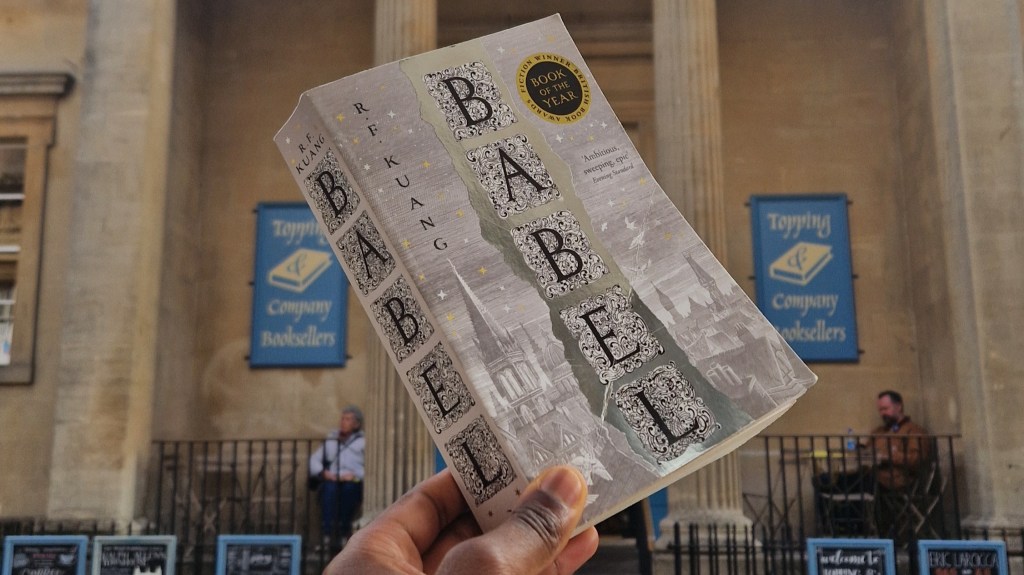

THE PLOT: ‘Babel’ by R.F. Kuang is blend of historical fiction and speculative fantasy. Set in an alternate version of Oxford in 1836, the British Empire has become rich off silver-working. The heart of this mysterious power is Babel: Oxford University’s prestigious Royal Institute of Translation. The main character is Robin Swift, a young boy orphaned in Canton and brought to England by a mysterious benefactor. Robin is given a prodigious education with the goal of him entering Oxford University as a coveted Babel scholar. But when Robin discovers that his intelligence and research will be used for nefarious means against indigenous peoples, he wonders if students can start a revolution that brings down an empire.
SUMMARY: I loved this book. I will always love this book. I will defend this book to the edge of the earth. So, where do we begin? At almost 550-pages, this novel is a sweeping epic that will appeal to lovers of dark academia, history and fantasy. Set in an alternate universe, it blends historical fact from the Victorian Era with a few speculative elements that twist the fate of history. The setting and world-building is incredibly rich and delicious. The plot is exciting as Robin Swift grows up like a David Copperfield or Oliver Twist – you want to learn more about his family and his mysterious benefactor, all while rooting for him to get accepted into Oxford University. Along the way he makes a close-knit cast of friends, each of whom are engaging characters you’ll fall in love with. But what makes this novel award-winning are the themes. This book is an intelligent exploration of colonialism, empire and patriarchy. It demonstrates how marginalised people need to come together to fight back against oppression. It weaves in poverty and feminism and makes us question the impact of the industrial (and by association the technological) revolution. This novel isn’t subtle and it isn’t perfect, but it’s bloody wonderful. I couldn’t put it down and will highly recommend it to anyone I come across.
GOOD BITS: This book is such an impressive work of fiction. From the core concept to the world-building, I appreciate how the author is able to draw together so many themes into a coherent argument about empire and exploitation. There’s no way I’ll do it justice in a review, so I’ll focus on the aspects I can describe. I loved the four main characters. The friendship between Robin, Ramy, Letty and Victoire was my favourite part of this book. They’re deliciously diverse in a way that makes sense within the world of the book (rather than ethnicities being plastered on for no reason). Each character represents a portion of society and empire, but their intersectionalities make the book sing. The characters speak to white feminism, what it means to be privileged, and loyalty to your friend’s vs loyalty to your values. I adored the short interludes from each of their perspectives, which added such richness to the story and allowed the reader to see outside of Robin’s mind.
NOT SO GOOD BITS: This novel is split into five books and I found book two a bit sluggish. Robin has very similar conversations about silver-working and empire with Griffin (multiple times), Professor Chakravarti, Powell and Ramy. They each have a function and serve to set out each character’s relationship to empire upfront, but they don’t move the plot forward or substantially deepen our understanding of the world-building. This makes it feel repetitive for the reader and some of these scenes could have been truncated. The author needed to trust that her reader understood the core concept of silver-working and language, and trust that the reader understands that the main character is processing his relationship to these things, and move on. Finally, as a classicist, I appreciate a deep-dive into linguistics and adore a bit of etymology. However, as this book is so long, I do think a few of those bits and the footnotes could’ve been cut down.
OVERALL: I’d recommend this book to fans of Phillip Pullman, N.K. Jemisin and Samantha Shannon. I’ve seen criticisms of this novel saying there’s too much overt racism and it reads like a thesis instead of a story. Art is subjective, but those people are wrong. So I implore you to read this and make up your own mind. In fact, buy it now.
You can purchase this book (with a discount) and support @aminasbookshelf via my bookshop.org. affiliate link.

 Amina's Bookshelf