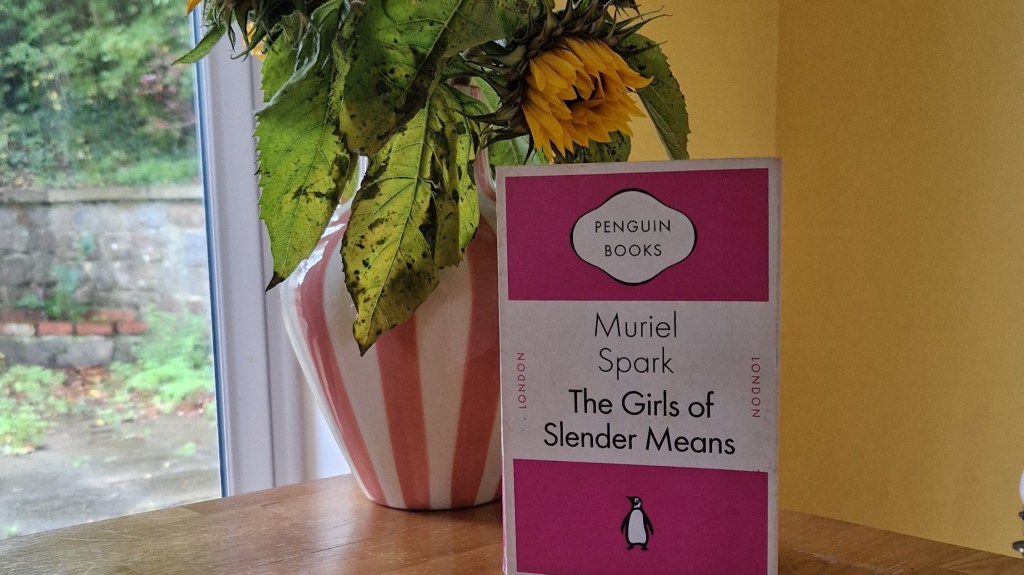

THE PLOT: ‘The Girls of Slender Means’ by Muriel Spark is a short novel by the famous Scottish author. First published in 1963, the novel is set in post-War London and follows a group of girls who live together in a boarding house, alternating between their past and present. The well-bred girls are living a normal life in abnormal times; fighting for suitors, sharing clothes and rationing coupons, until their innocence is destroyed by the tragedy of the period.
SUMMARY: This is a strange but compelling little novel. At 140-pages it’s as slender as its title, yet the complex narrative structure meant it took me a while to read. Alternating between snippets of scenes from different time-periods and perspectives, I worried that it’d lack a central storyline. However, the narrative does come full circle and there is a plot focussed on the brief period between VE day and VJ day in 1945. Overall, I’m not sure what to make of this one. It has all the hallmarks of Muriel Spark’s genius – satire, social history and unusual characters. Yet it was too fragmented for my taste. Perhaps it was an experiment with narrative voice and form, particularly in the way it uses phone calls and small snippets of dialogue as scenes. But I’m not sure it entirely worked for me, which is why I’m giving it three stars.
GOOD BITS: I loved Muriel Spark’s most famous novel, ‘The Prime of Miss Jean Brodie’, so when I spotted this in a second-hand bookshop, I simply had to snap it up for £3. Although I didn’t love it, I’m not disappointed because the strong world-building evoked and educated me about a very specific time (the strange uncertainty during the months after Victory in Europe was declared). I don’t want to write any spoilers, but the ending was fitting and, for me, put the whole novel into context.
NOT SO GOOD BITS: I really liked the characters. In particular, Jane, Selina, Greggie and the American serviceman with a wife back-home provided a lot of entertainment. However, I felt the premise was so rich that more could have been made of them. That’s why the format grated on me so much – it felt like a waste of these great characters in this remarkable situation. Also, the novel comments on the girls’ weight a lot. This is to be expected from a book published in the 1960’s and it’s an important play on words within the novel, but it could grate on modern readers.
OVERALL: I’d recommend this book to fans of ‘The Lonely Londoners’ by Sam Selvon, ‘Wigs on the Green’ by Nancy Mitford’ and ‘The Misinterpretation of Tara Jupp’ by Eva Rice. Although I didn’t love this book, it certainly hasn’t put me off reading more of Muriel Spark’s work in future.
You can purchase this book with a discount and support @aminasbookshelf on my bookshop.org page.

 Amina's Bookshelf