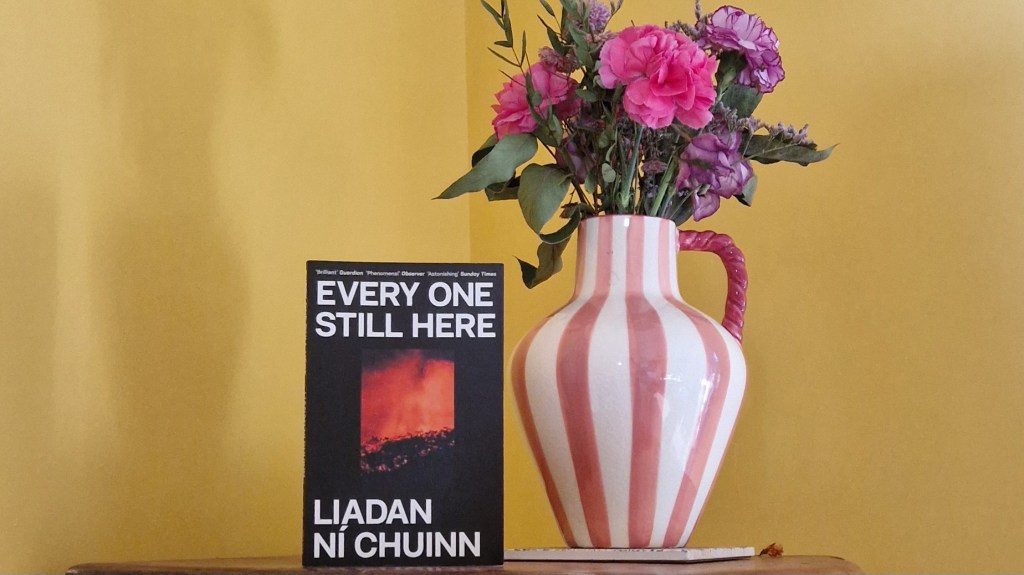

THE PLOT: Every One Still Here by Liadan Ní Chuinn is a short story collection set in Northern Ireland. The stories open with Protestants hijacking a Catholic family’s car and end with a list of civilians murdered by British state forces. While not every story is directly about the Troubles, they form a consistent backdrop to the characters. From a medical student coming to terms with their dad’s death to a teenage girl finding solace in her boyfriend’s family, the stories blend every day struggles with the political context.
SUMMARY: At c.150-pages with six stories, this debut collection explores intergenerational trauma as a result of sectarian and state violence in Northern Ireland. It features haunting, sad characters, many of whom are searching for familial love amidst a backdrop of political turmoil. Themes of fertility and family are coupled with a frequent motif of terminal illness and death. Yet what really struck me was the inherent loneliness of the characters, most of whom were fruitlessly grasping for connection. Although I struggled with the initial stories due to the spare, disconnected writing, the strength and sorrow of this stripped-back style comes to the fore as you, the reader, are the only ones able to connect with the characters. So, despite my initial impressions, these stories were strangely visceral and I’ll be thinking about these characters for many years to come.
GOOD BITS: The characters in this collection are so vivid they remain in my head long after reading. This is probably because I read several passages aloud (in a terrible Irish accent) to capture the cadence and stop my mind wandering. While my favourite stories were ‘Novena,’ ‘Mary,’ ‘Daisy Hill,’ and ‘Russia,’ the first was particularly moving for its depiction of characters who avoid letting others in. For example, Tara’s use of social media and Felix reluctantly divorcing his wife left me with a profound, modern sadness about the loneliness epidemic. Ultimately, the collection culminates in the powerful ‘Daisy Hill,’ which bears witness to those murdered by British state forces in Northern Ireland. In our current era of rising neo-fascism and state-inflicted violence, this act of remembrance makes the reader reflect on the endless cycles of violence and exploitation, and its impact on future generations.
NOT SO GOOD BITS: The writing style is very sparse and reads like direct speech. There’s little use of quotation marks and sentences are frequently repeated. If I’m honest, this put me off the book initially. The staccato sentences kept tripping me up and I often had to go back and read paragraphs again. This prevented me from connecting with the first couple of stories and I fear I might have DNF’d this book early on. Like modern-art colour-block on canvas, it felt like any teenager could’ve written these simple stories. However, as I progressed through the collection and was able to sink into the rhythm of the writing, I began to understand why this book has been so lauded.
OVERALL: I’d recommend this book to fans of ‘Milkman’ by Anna Burns, ‘The Queen of Dirt Island’ by Donal Ryan and ‘Trespasses’ by Louise Kennedy. Thank you to the Sunday Times, Young Writer of the Year Awards for my #gifted copy as part of my role on as a Shadow Panel Judge. You can purchase this book (with a discount) and support @aminasbookshelf via my bookshop.org. affiliate link.

 Amina's Bookshelf