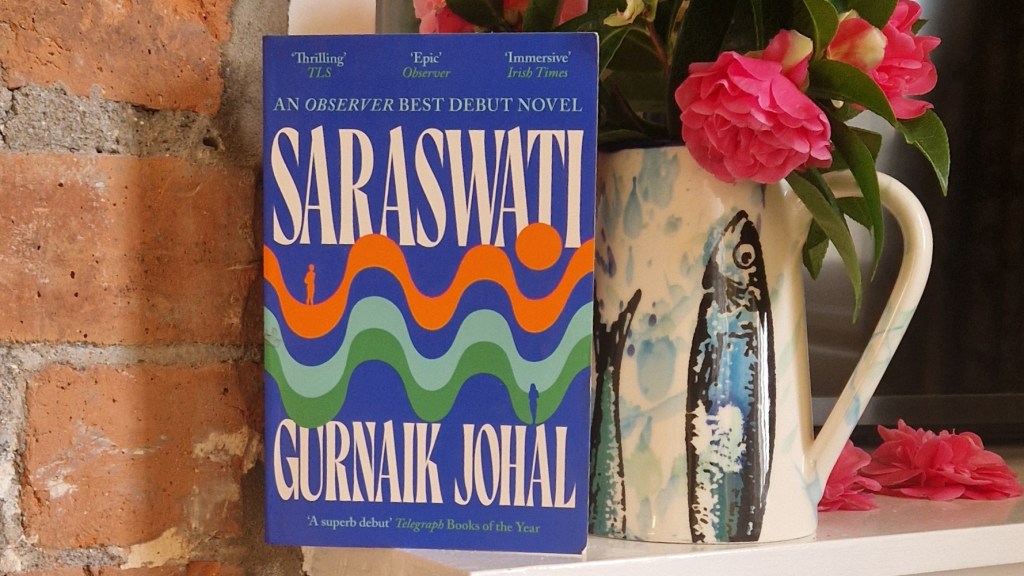

THE PLOT: Saraswati by Gurnaik Johal is a multi-generational family saga about seven descendants of a forbidden marriage who are connected by a legendary river. In 1878, Segal and Jugaad meet in a small village in Northern India. Unable to marry, they flee down river and live on a small farm with an abundant well. They name their seven children after local rivers but over time the well runs dry and their children move to different corners of the world. Around 150 years later, when Satnam’s grandmother dies he inherits a farm in India. Adrift from his life in London, he plans to sell the farm until he notices that the long-dry well is suddenly full of water. As Satnam is drawn into a contentious scheme to restore the Saraswati river, a ripple-effect of events connect long-lost cousins. An archaeologist in Nairobi, a stuntman in Singapore, a musician in Canada, an environmentalist in Mauritius, and an orphan in Pakistan. Across the lands of Empire, the descendants of Segal and Jugaad are drawn back to the river that birthed them.
SUMMARY: You can probably guess by the long plot summary, but this novel is a lot! In less than 400-pages, you’re introduced to so many continents and characters – it’s hard to keep up. With themes of environmentalism, neo-capitalism, far-right politics and the legacy of Empire, it’s an incredible feat of work with an extremely wide scope. Was I routinely confused about who was who? Yes. Did I adore this novel anyway? Yes. This book is absolutely my cup of tea. The writing is beautiful, the characters were flawed (and, therefore, compelling), the plot was engaging, and the themes were intelligent. While I do think the author could’ve pared it back a bit by reducing the number of “stories within stories” and letting the characters breathe, I’ll be recommending this book to everyone I meet. This would be such a strong book for a buddy read or bookclub as you could debate it for hours.
GOOD BITS: The intricacies of this debut are intense, but it’s ridiculously absorbing. Each character has their own storyline (with subplots and side characters) but the author hangs it together with an engaging central mystery. It almost feels thriller-like because the reader wants to learn more about the corruption at the centre of the Saraswati river project. Although literary on the surface, this novel is genre-defying and I wondered if it was set in a near-future because it gives slightly speculative vibes. As a Dubai-esque city is built alongside the fictional Saraswati river in India, it’s almost an environmental and political warning. An incredibly complex novel to execute (and summarise), I somehow loved the slightly futuristic elements more than the historical elements.
NOT SO GOOD BITS: The author could have stripped this novel back to have more impact. While I loved the characters, I felt like they were abandoned after their central chapters. For example, I never felt 100% satisfied with Satnam’s motivations and kept thinking they’d be explored in more detail through another character’s eyes. The recurring “story within a story” structure, while thematically tied to folklore and voiceless narratives, often feels confusing and distracts from the main plot. The complex web of relationships can also be difficult to follow so I feel like a family tree would have been helpful. Additionally, the shift between third- and first-person narration for one character comes across as jarring. I think the aim was to emphasise that she brought everyone together and was telling the story (in places), but I felt it was unnecessary.
OVERALL: I’d recommend this book to fans of ‘Midnights Children’ by Salman Rushdie, ‘Black Cake’ by Charmaine Wilkerson, ‘The God of Small Things’ by Arundahti Roy, and ‘A History of Burning’ by Janika Oza. If you love a multi-generational novel about the histories that bind us and their effect on the future, pick this up now. Thank you to the Sunday Times, Young Writer of the Year Awards for my #gifted copy as part of my role on as a Shadow Panel Judge. You can purchase this book (with a discount) and support @aminasbookshelf via my bookshop.org. affiliate link.

 Amina's Bookshelf