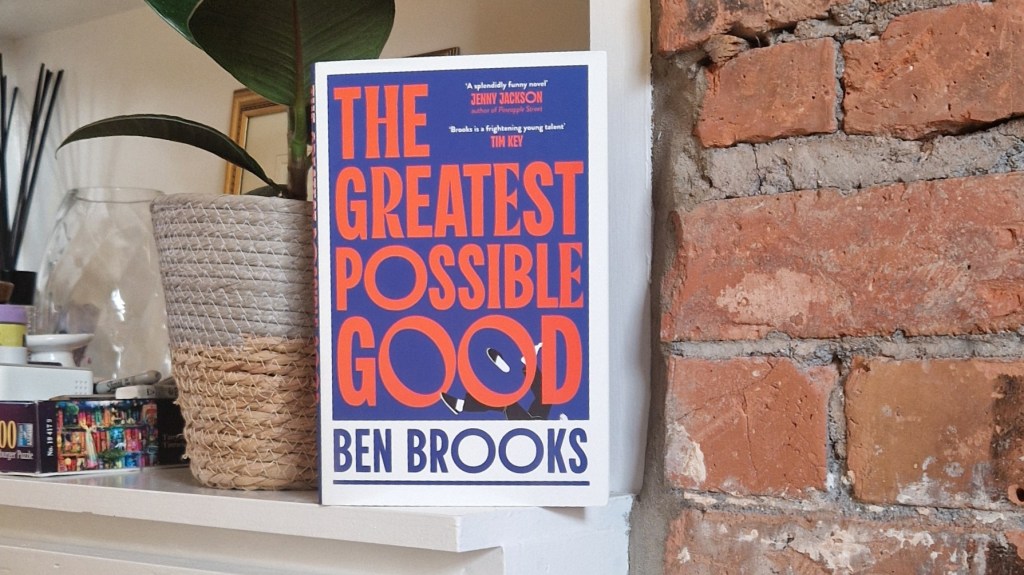

THE PLOT: The Greatest Possible Good by Ben Brooks is a contemporary novel about a wealthy family divided by altruism. Arthur Candlewick is about to sell his company for millions when he falls down a disused mineshaft. After three days with only his son’s drug stash and his daughter’s book on ethics for company, he is rescued and decides to give away his earnings to charity. His family think he’s lost his mind and the fallout of losing their privileged lifestyle of Cotswold mansions and private schools haunts them for years.
SUMMARY: I have no idea if I liked this book. Part of me resonated with the message about trying to help others. Part of me couldn’t care less about these characters. So, let’s start with the concept. The central question of this novel is “what does it take to live a good life?” It asks whether those with privilege should give away as much as possible to charitable causes, or if there are other – more moderate – ways to help others by focussing on our own family and friends first. This was an interesting premise and I kept weighing up the different characters to see who I agreed with. However, I did get tired of circling the same wagon over and over again. I enjoyed the satire as Arthur tried to live as frugally as possible, but I felt there were no true consequences to his decision and the novel lacked any real stakes. Overall, I don’t think this book was bad but I don’t think it resonated with me. It was just fine.
GOOD BITS: The characters were all slightly unlikeable, which is something I’m drawn to in novels. I want characters who aren’t perfect and have to make difficult choices because I feel it reflects the truth of human nature. Wanting to understand their motivations kept me going with this book and I felt they were very well-drawn. However, their familiarity made them uninteresting to me. I know loads of champagne socialists who went to private school. Even though the author threw in lots of ups and downs, I knew they’d be fine so I couldn’t really care about them. I understood them but I just couldn’t empathise with them.
NOT SO GOOD BITS: Though the characters were well-observed, the plot meandered and the scope was too large. The book spans 10-ish years but I feel a truncated time-period might have had more impact. Although the author threw in lots of plot points to keep the story going (abusive relationships, teenage pregnancies and drug abuse), the characters still had enough money and a safety net to be comfortable. Obviously, it’s a novel so characters and events need to be exaggerated but I just didn’t believe in their actions. Arthur didn’t need to be so charitable to his own detriment. Evangeline’s “principles” about abortion baffled me. Emil could have got any mediocre office job (like many unexceptional private school boys) and the inclusion of his novel was unnecessary. And while I liked Yara’s boyfriend as a disruptive force, their nuptials just didn’t make sense. Perhaps that’s what stopped me from engaging with this novel – the driving force of the plot didn’t ring true to me.
OVERALL: I’d recommend this book to fans of ‘All Adults Here’ by Emma Straub and ‘Pineapple Street’ by Jenny Jackson. Thank you to the Sunday Times Young Writer of the Year Awards for my #gifted copy as part of my role on as a Shadow Panel Judge. You can purchase this book (with a discount) and support @aminasbookshelf via my bookshop.org. affiliate link.

 Amina's Bookshelf