
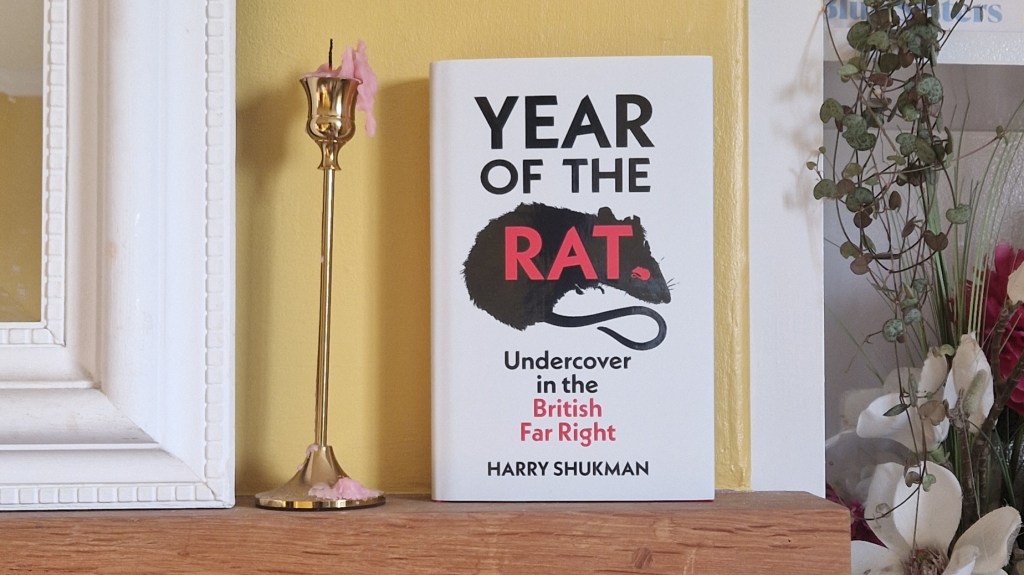

THE PLOT: Year of the Rat by Harry Shukman is non-fiction about fascism, racism and antisemitism. For over a year, Harry lived a double life. Friends and family knew him as a journalist, but he was secretly infiltrating the British far right. Equipped with a hidden camera, he posed as ‘Chris’ and set out to expose right-wing extremists. From canvassing with Britain First to befriending Holocaust deniers, neo-Nazis and a Silicon Valley-backed race-science organisation, Shukman risked his safety and sanity to remove the far right’s terrifyingly everyday mask.
SUMMARY: Year of the Rat is an unsettling and, at times, deeply frightening exploration of the rise of far-right ideology in Britain. Through undercover work, Harry Shukman exposes not just the existence of extremist networks, but how widespread and interconnected they’ve become, particularly through social media. What’s most disturbing is that these aren’t fringe figures or stereotypes of “outdated old men.” Many of the individuals drawn into these movements are young-men in their 20s and 30s who otherwise appear ordinary. The book highlights how digital spaces accelerate and normalize extreme beliefs, turning them into something that feels increasingly mainstream. Having experienced racist abuse and threats myself after my move to rural England, the themes of the book felt painfully real and immediate. That personal context made the reading experience all the more intense and is why I’m recommending this book to everyone I meet.
GOOD BITS: One of the book’s greatest strengths is how it shows just how insidious these ideologies are. They don’t always present themselves as overt hatred; instead, they’re woven into narratives about identity, economics and isolation. There’s an undercurrent of ruthless competition—an almost cynical worldview shaped by capitalism, where success is framed as keeping others down. Shukman’s immersive approach also succeeds in exposing spaces that many people would never otherwise see. At a time when there’s ongoing debate (particularly in left-leaning circles) about whether engaging with or “platforming” extreme views is harmful, this book makes a strong case for exposure. You can’t confront what you refuse to look at.
NOT SO GOOD BITS: At times, I found myself questioning the tangible impact of Shukman’s infiltration. The level of effort, time, and resources involved—particularly given the backing of a charity—raises the question of what concrete difference it ultimately makes. While the book is undeniably a powerful exposé, its real-world outcomes feel less clear. When the beliefs are rooted in discredited ideas like eugenics and race science, it feels baffling and futile to combat them in our post-truth social media driven world. There’s also a sense that, while the book successfully surfaces the problem, it doesn’t fully grapple with solutions. If anything, it reinforces a difficult truth: that many people immersed in these ideologies are unlikely to be persuaded otherwise.
OVERALL: I’d recommend this book to fans of Men Who Hate Women by Laura Bates, Doppelganger by Naomi Klein, and Black Klansman by Ron Stallworth. Year of the Rat is not an easy read—but it shines a light on a growing and deeply troubling movement, reminding us that extremism doesn’t always look the way we expect it to. It may not offer clear answers, but as a starting point for awareness and conversation, this book feels both timely and necessary. Thank you to the Sunday Times Young Writer of the Year Awards for my #gifted copy as part of my role on as a Shadow Panel Judge. You can purchase this book (with a discount) and support @aminasbookshelf via my bookshop.org. affiliate link.

 Amina's Bookshelf