
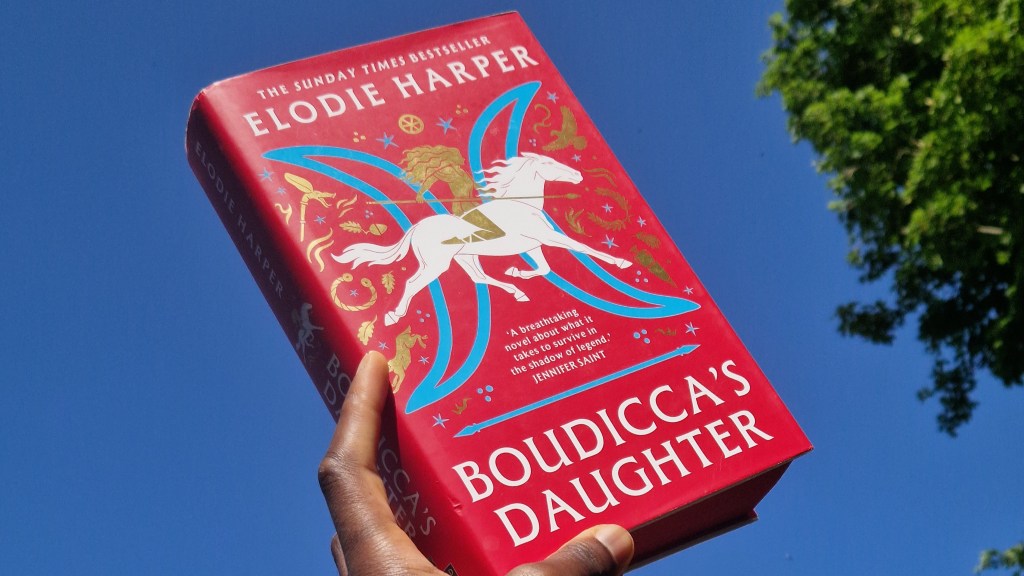

THE PLOT: Boudicca’s Daughter by Elodie Harper is a historical novel set in Ancient Britain during the Roman occupation. Solina is the daughter of Boudicca, the fierce queen of the Iceni tribe, and a powerful druid king who rules under Rome’s authority. After her father’s death, the Romans brutally abuse Solina and her sister, driving Boudicca to seek vengeance and lead a massive rebellion against Roman rule. As Solina grows up in the shadow of her legendary mother, she must decide whether to live up to Boudicca’s legacy or forge her own path in a Roman-controlled world.
SUMMARY: As a huge fan of The Wolf Den trilogy, I went into Boudicca’s Daughter with sky-high expectations. I even bought the novel in special edition hardback – I was that excited. And while I did enjoy it, the book never quite lived up to the standard set by Harper’s earlier work. The biggest issue was that the novel felt oddly disjointed. The multiple POVs, uneven pacing, and large time jumps made it hard to fully connect with the characters. Solina, in particular, never felt emotionally convincing to me. Her love story and betrayal of her culture seemed driven more by plot than personality, which was disappointing because Harper usually excels at creating messy, deeply human characters. That said, the atmosphere was excellent and this still a solid historical novel from a talented writer. However, it feels less focused and ultimately less memorable than her previous work.
GOOD BITS: Historical novels set in Ancient Britain are surprisingly difficult to pull off — perhaps because the characters and world can feel so distant and unfamiliar — but Elodie Harper captures the atmosphere beautifully. The imagery of forests, druids, and roundhouses gives the novel a vivid sense of place, while the emotional fallout from the central assault is portrayed with rawness and intensity. I only wish the lasting impact of that humiliation had remained more central throughout the story. I also appreciated the subtle nod to The Wolf Den through the appearance of a young Senovara. Once the novel shifts to Ancient Rome, it becomes even more compelling. The worldbuilding feels richer and more immersive, and the political manoeuvring at court played directly to my interests.
NOT SO GOOD BITS: This novel felt too disjointed for my taste. I usually enjoy multiple POVs, but here the first-person narration often relied on characters explaining their emotions rather than revealing themselves through action, which made it hard to fully connect with them. While I liked Palinas’ perspective, it didn’t feel like the story I signed up for, and his narration seemed mainly designed to make the romance more convincing. Solina also undergoes a dramatic transformation over the course of the novel, but instead of feeling organic, her development felt inconsistent. By the end of the book, both her lifestyle and values are almost unrecognisable from the person she was at the start, yet the emotional journey between those two versions never felt fully earned. Too often, her choices seemed driven by the needs of the plot rather than by her established personality. This was especially noticeable in the second half, which felt like an entirely different novel, as Solina adapted to life in Rome with surprisingly little resistance or reflection on her Britannic upbringing.
OVERALL: I’d recommend this book to fans of The Daughter of Black Lake by Cathy Buchanan, Lavinia by Ursula Le Guin, and Ariadne by Jennifer Saint. You can purchase this book (with a discount) and support @aminasbookshelf via my bookshop.org. affiliate link.


