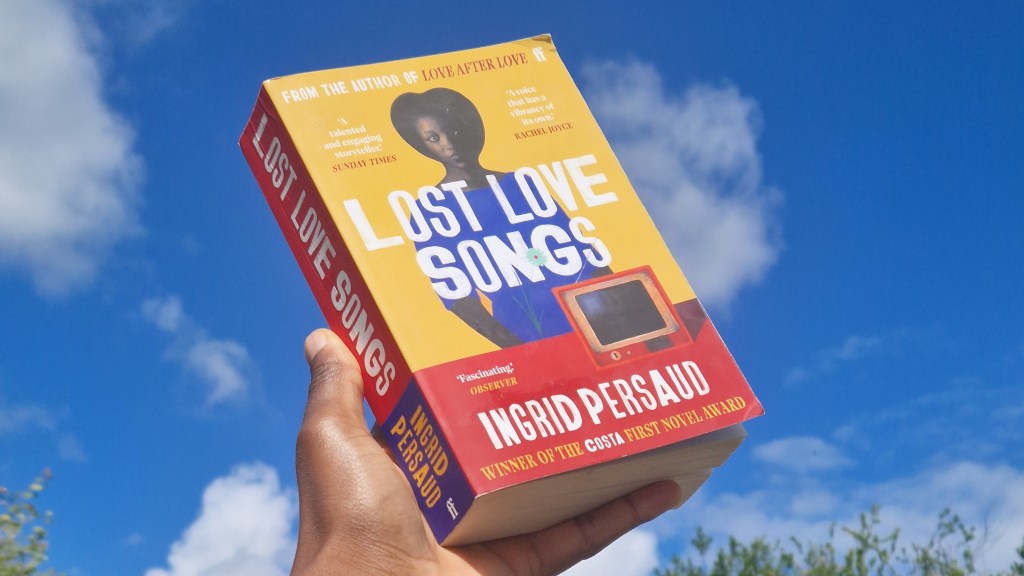

THE PLOT: The Lost Love Songs of Boysie Singh by Ingrid Persaud is about four women connected to a gangster in 1950’s Trinidad. Popo is a sex-worker determined to free herself from her past. At first Boysie is just a customer, but she helps him start, manage and grow his business in the hopes of a better life. Mana Lana is deeply devoted to Boysie. Childhood sweethearts and the mother of his only child, she longs for the day that Boysie will choose her. Doris is beautiful and ambitious yet she’s only a maid. When the successful, rich Boysie starts courting her, she’s ecstatic with the life of luxury he can give her. Rosie is a shopkeeper who is forced to pay “rent” to Boysie. She wants a quiet life but when Boysie goes after her girlfriend, she’s determined to get justice. As Boysie’s criminal empire grows, so does his ego and there’s only so much each woman can take.
SUMMARY: This novel is inspired by the real Trinidadian gangster Boysie Singh, who was hanged for murder in 1957. Rather than centring the notorious criminal himself, Ingrid Persaud tells the story through the perspectives of four women whose lives he shaped. This is an inspired narrative choice that completely subverts the myth of the gangster. Instead of glorifying Boysie, the novel exposes him as weak, insecure and ultimately pathetic, while allowing the women to take centre stage.
Each of the four women is beautifully realised. They are layered, vulnerable and fiercely human, and I found myself becoming deeply invested in all of their stories. Persaud combines these unforgettable characters with an immersive portrait of Trinidad’s Indian history, culture and religious diversity, resulting in a novel that is both educational and enthralling.
By refusing simplistic moral binaries, the novel captures the messy contradictions of real life: it allows readers to understand each character’s motivations for their difficult and sometimes cruel actions. At over 500 pages, it never outstays its welcome, and I found it to be an absorbing, compassionate and beautifully crafted read that will stay with me for a long time.
GOOD BITS: Despite its length—over 530 pages—this is an incredibly engaging read. The short chapters and multiple perspectives give the novel real momentum, making it surprisingly easy to fly through. The novel is rich in social, political and cultural detail, and I came away feeling I had learned a great deal about the country’s history. I especially enjoyed the exploration of Indo-Caribbean identity, with religion and mysticism woven naturally into the characters’ lives and the wider historical context.
One of the novel’s greatest strengths is its refusal to flatten its characters into heroes or villains. Doris is unapologetically ambitious, and, while I suspect she’ll be a divisive character, I found her snobbish and grasping attitude relatable and understandable. Mana Lana commits some terrible crimes to protect Boysie, yet I understand her vulnerability and mental trauma. Popo’s attempts to free herself from exploitation lead her to build a business based on the exploitation of others. Finally, small glimpses into Boysie’s childhood evoke moments of sympathy without ever excusing the horrific violence he commits. These tensions allow the novel to examine how people are shaped without absolving them of responsibility.
NOT SO GOOD BITS: I honestly struggle to find much to criticise. The only slight drawback is that, with four narrators, it takes a little while to settle into the rhythm of the novel and distinguish each voice. However, this is only a temporary hurdle, and once the characters become familiar, the structure becomes one of the book’s greatest strengths.
Rosie’s POV was the one I connected with the least. At first, I wondered what her significance was and she took me away from the POVs I cared deeply about. However, I appreciate her inclusion because she’s a bi-sexual character and the one who ultimately stands up to Boysie. This is extremely clever narrative device because she provides additional layers of nuance in the storytelling. Her romantic same-sex relationship is portrayed with tenderness and care, adding another dimension to the novel’s exploration of love and resistance, and her unashamed sexual appetites feel like a deliberate commentary on Boysie’s impotence.
OVERALL: I’d recommend this book to fans of In the Time of the Butterflies by Julia Alvarez, What A Mother’s Love Don’t Teach You by Sharma Taylor, and Augustown by Kei Miller. You can purchase this book (with a discount) and support @aminasbookshelf via my bookshop.org. affiliate link.


