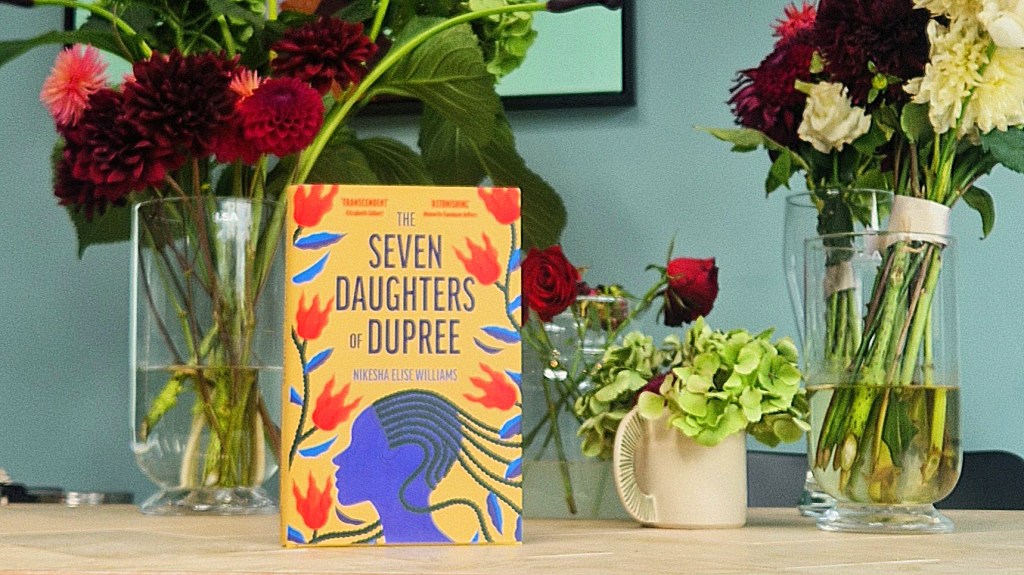

THE PLOT: The Seven Daughters of Dupree by Nikesha Elise Williams is a family saga about seven generations of Black women in an American family. It’s 1870 and the only thing mixed-race Emma knows about her mother is that she was a slave her father impregnated. So, when her father leaves his plantation to Emma in his will, it’s a shock to the whole community. Emma’s descendants are forever connected to the land. Jubi in 1917 who tries to pass as white. Ruby in 1934 who falls in lust with a boy from the city. Gladys in 1953 whose attempts at respectability trickle all the way down to her granddaughter Tati in 1995, who is desperate to find her biological father. The Dupree women share a legacy and curse passed down from mother to daughter.
SUMMARY: This novel has left me torn. On the one hand, I ended it with a sense of satisfaction and understanding. On the other hand, I struggled through sections and thought I would DNF at points. My main issue was the structure. The 1995 and 1980’s storylines were more confusing than compelling at first. They only made sense once I’d finished the whole book, and I was even tempted to start reading again from the beginning so I could appreciate the novel with the benefit of hindsight. This is an extremely complex novel with multiple POVs and storylines so I don’t envy the author their structural issues. However, I think a more linear telling would have helped. The author withheld so much for a dramatic payoff at the end but it meant the opening chapters were difficult to understand on a basic level. However, when reflecting on this novel I can truly understand the positive reception as it does feel like one that will stay with me. While this isn’t my favourite multi-generational family saga, I would still recommend it to fans of the genre because it does have a special spark that I’ll be ruminating on for years to come.
GOOD BITS: I enjoyed the historical sections the most, particularly Emma, Jubi, Ruby and Sarah’s storylines. They felt like the most cohesive and I could understand both the character motivations and the holistic narrative. As with many multi-generational novels, I often found myself reading the other sections quickly so I could get back to the historical ones. And, for better or worse, I felt a sense of relief when I re-engaged with these characters as they sustained my interest.
NOT SO GOOD BITS: To elaborate on the structural issues, I found using two names for one character (Gladys/Mimi) was confusing in a novel where you’re moving rapidly between POVs. For example, if Gladys’ story was told linearly without having to guess what happened to her it would’ve provided useful context for her interactions with Tati and Nadia. As it currently reads, Gladys felt way too hard on Tati and Nadia, as if she had very little love for her child. I know this is explained later but it stopped me from believing in the book at first because it seemed so unrealistically harsh.
The confusing structure and lack of context meant I only understood in part two (over 100 pages in) that Tati’s storyline was about finding her biological father. I personally couldn’t relate to her obsession to find him at the expense of her mother’s feelings. The conclusion to her story felt inevitable to me and it made the character feel dumb that she wouldn’t have worked this out herself.
Another issue is that the ending of the novel felt extremely graphic. There’s a final scene where you get a big reveal about Emma’s mother, the original ancestor who was shipped from Africa. While I did feel extremely invested in their whole storyline and I am not one to shy away from the realities of slavery or difficult depictions in art, this is one of the most harrowing descriptions of torture that I have ever read. It felt somewhat egregious and, perhaps, a step too far. I wonder if the reveal is withheld for so long that the author had to go extreme to provide shock value.
Finally, the whole narrative is predicated on a slaveowner leaving his plantation to his mixed-race child. Given the shocking ending, I just don’t understand this. It feels extremely unrealistic, particularly as he was very cruel and had white sons. Maybe I missed something, but it just feels odd and undermines the whole premise.
OVERALL: I’d recommend this book to fans of The Love Songs of W.E.B Du Bois by Honoree Fanonne Jenkins, Homegoing by Yaa Gyasi and Black Candle Women by Diane Marie Brown. If you’re a fan of multi-generational novels about Black women, give this book a try. It’ll certainly give you a lot to reflect on.
You can purchase this book (with a discount) and support @aminasbookshelf via my bookshop.org. affiliate link.
You can also pre-order the paperback, which is out on the 14th January 2027.


